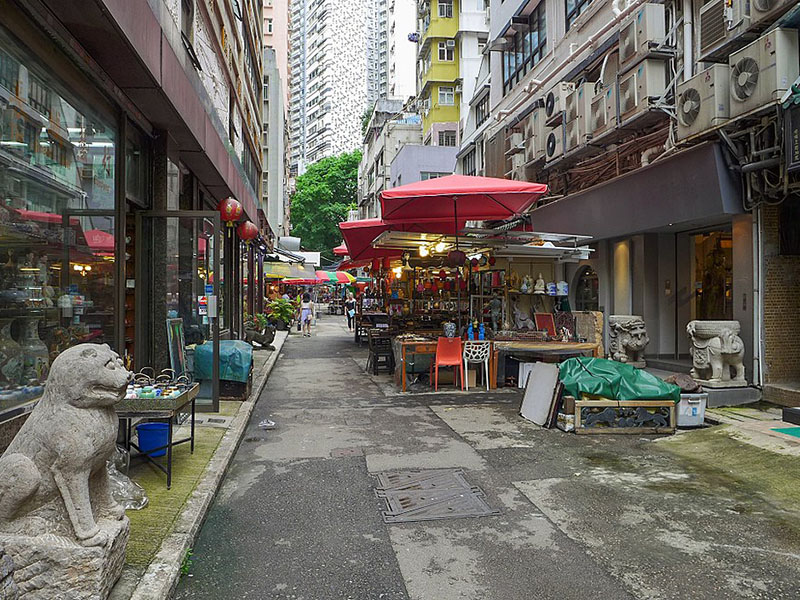
Old Town Central: Nostalgic antique street, trendy creative shops, attract collectors and bring home antique features
In the early days of Hong Kong’s opening as a port, many Indian sailors and soldiers liked to gather here
to sell goods. At that time, Hong Kong people already liked to call Indians "嚤啰" (Indians who believed in
Sikhism), so this street was called Mo Luo Street. As for the English name, it is also related to Indians. Lascar
is derived from Arabic and Persian Lashkar, originally referring to devout troops, soldiers, and guards, and has
since been extended to all parts of Asia, especially Indian seamen. One said it was simplified from Musselmen
to Morra and was called "嚤啰". In addition, Moro Street is also known as Cat Street (English: Cat Street) because
there are many shops dealing in antiques, and there are also many "grocery stalls." Foreigners describe those who
buy rat goods like cats, so they call it "cat street."
Morro Street has been a second-hand market since the 1920s and 1930s. Apart from expensive artworks, the antiques it sells also include other miscellaneous goods. Including antique appliances, old toys, old postcards and posters, etc., it is a good place for people who love nostalgic objects to hunt for treasure. Due to the historical characteristics of Morro Street, the Hong Kong Tourism Board recommended to overseas tourists that Morro Street is a good place to sell silk, embroidery, jade and wood products. In addition, Moro Street has also been introduced in tourism publications and is internationally famous. Therefore, many Chinese and foreign tourists are attracted to visit, shop and shoot, and many antique art shops are also attracted to open shops here and nearby Hollywood Road.
 EN
EN  ZH
ZH